Loading…
Bapsule EV Docks
AC and DC charging equipment, specified per model.
Four groups — Socket AC, Type 2 AC, DC Wallbox and DC Floor — with model-specific connectors, cable, mounting, controls, protection and communication. Filter by what the site needs, compare up to three configurations, and request a quotation with the context kept.
- Quoted per configuration
- 12 catalogue configurations
Four groups
Start from the connector and the site.
3.3 kW catalogue
Socket AC
3.3 kW socket chargers for two- and three-wheelers and light vehicles that charge from their own cable; wall or pedestal mounted.
3 catalogue configurations · 2 on enquiry
7.4 – 22 kW catalogue
Type 2 AC
Tethered Type 2 AC docks from single-phase to three-phase for destination, workplace and fleet charging; a portable personal charger on enquiry.
3 catalogue configurations · 3 on enquiry
20 – 30 kW catalogue
DC Wallbox
Compact CCS2 DC chargers for walls and pillars where floor space is limited — depots, dealers and workplaces.
2 catalogue configurations · 1 on enquiry
30 – 120 kW catalogue
DC Floor
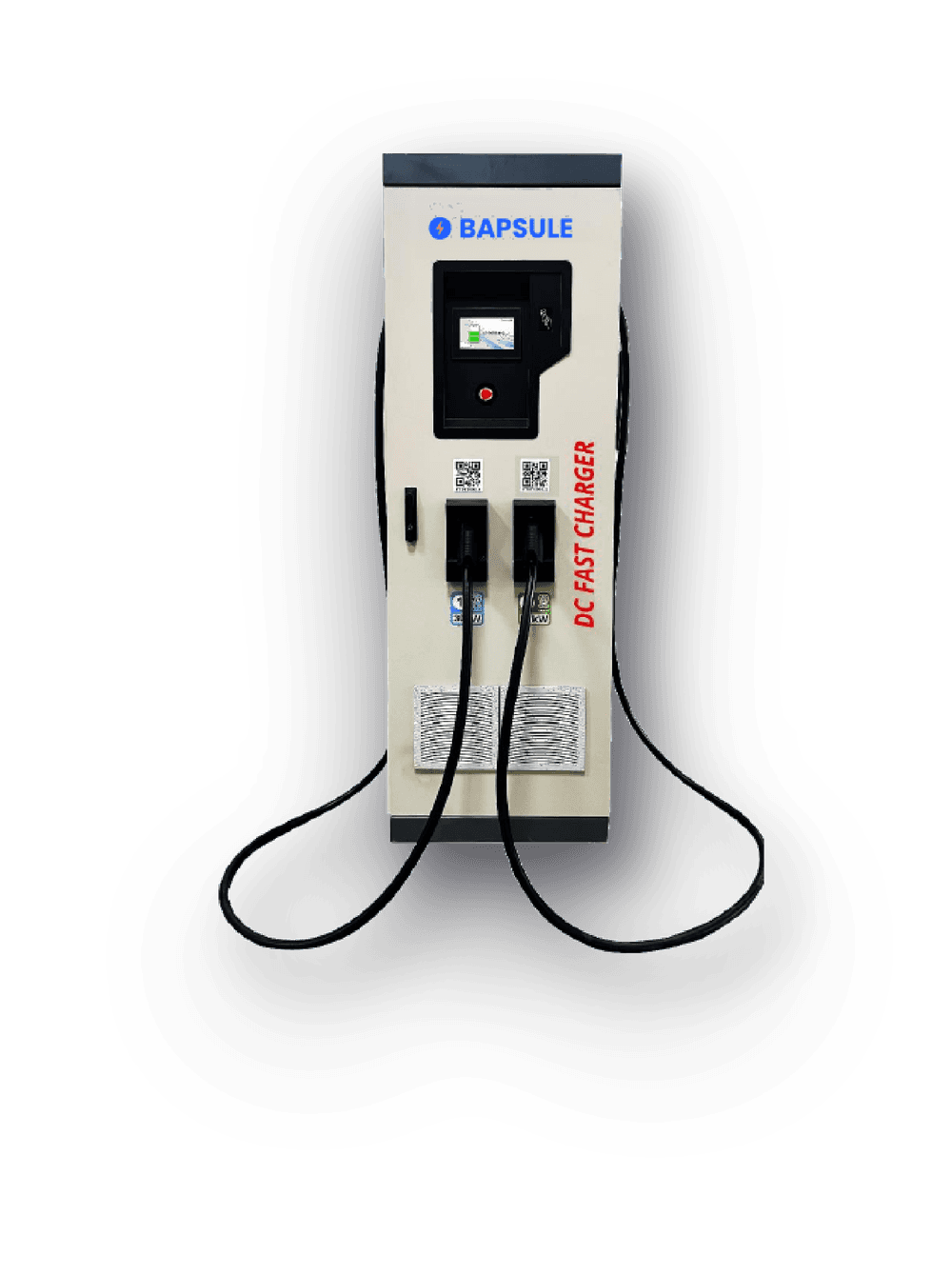
Floor-standing CCS2 fast chargers with one or two guns for fuel stations, corridors, depots and hubs.
4 catalogue configurations · 4 on enquiry
Filter and compare
Find the configuration for your site.
The twelve catalogue configurations can be added to a comparison; families without a priced configuration appear as enquiry configurations.
Loading filters…
Every dock is quoted per configuration: model and revision, connectors and cable, mounting, controls, protection and communication option, with site items listed separately. Other capacities (3.3 and 43 kW Type 2 AC; 180 / 240 / 360 kW DC) are enquiry configurations.
Installation and connectivity
What every dock needs from the site.
Supply
230 V single-phase for socket and low-power AC docks; 410 / 415 V three-phase for higher AC and DC units. The exact SKU input rating, permissible range and maximum current set the site design demand.
Protection and earthing
Each charge point on its own circuit with upstream protection and residual-current protection, earthing to the applicable code and surge protection per the electrical design.
Mounting
Wall or pedestal brackets for socket and Type 2 docks; a raised plinth with cable-trench entry and bollards for floor cabinets; a load-bearing wall or pillar for DC wallboxes.
Connectivity
Wi-Fi, cellular or Ethernet per model, with RFID and QR or app authentication through the operator's charging management system; offline modes where the model supports them.
Site items are quoted separately and clearly.
Pedestal or plinth, upstream protection, cable runs, utility work, CMS subscription, payment integration and commissioning are listed beside the equipment so the quotation reconciles with the site.
Questions
Before you enquire about docks.
Which docks can I order today?
Twelve catalogue configurations have a model code and a source-stated specification and are quoted per configuration. Other capacities and variants are enquiry configurations: their specification, availability and scope are confirmed per project.
Are prices published?
No. Every dock is quoted per configuration so the quotation can state the model and revision, connectors and cable, mounting, controls, protection and communication option, with site items listed separately.
Does a dual-gun charger charge two vehicles at full power?
No. Two guns share the cabinet rating; per-gun output depends on the sharing scheme, the vehicles and derating, and is stated per model at quotation.
Which vehicles are compatible?
Compatibility depends on the connector and the vehicle: Type D sockets serve vehicles that carry their own cable, Type 2 serves AC-charging cars and light vehicles, CCS2 serves DC fast-charging vehicles. It is confirmed per model and vehicle; universal compatibility is not claimed.
Do the docks work with my charging management system?
The catalogue states OCPP 1.6J for the networked models and proprietary control for standalone variants. Each dock-and-CMS pairing is demonstrated during commissioning; the website promises only demonstrated functions.
What is the environmental rating?
Ingress and impact ratings differ between catalogue pages for some families, so they are confirmed per model and revision rather than published as one universal rating.
Enquire
Describe the site and the vehicles.
Number of bays, vehicle types, supply available and mounting position are enough for a first configuration.